



03 Sep How Much DHOAS Can You Get? Subsidy Breakdown by Tier
If you’re trying to work out how much DHOAS you can actually get, the honest answer is: it depends on more than your tier. Your recognised service, your home loan balance, and the applicable subsidised loan limit all play a part which means the maximum amount isn’t necessarily the number you’ll see land in your account.
For 2026–27, the maximum monthly DHOAS subsidy is approximately $588 for Tier 1, $882 for Tier 2 and $1,176 for Tier 3. These are ceiling figures. Your actual subsidy may be lower, depending on your eligible loan balance and your individual circumstances.
How DHOAS Is Structured
Your DHOAS tier sets the maximum subsidised loan limit available to you. Your home loan balance then determines how much of that limit is actually used in the subsidy calculation.
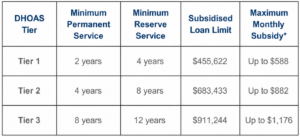
*Based on 2026–27 figures and the median interest rate used by DHOAS. Monthly subsidy amounts can change when that rate changes.
The tier sets the ceiling. Your loan balance determines how much of that ceiling you can actually use.
For example, a Tier 2 member with a $500,000 DHOAS home loan doesn’t automatically receive the full $882 monthly maximum. Because the loan sits below the Tier 2 subsidised loan limit, the subsidy is calculated against the eligible $500,000 balance and not the limit itself.
What Is DHOAS?
The Defence Home Ownership Assistance Scheme (DHOAS) provides eligible current and former ADF members with a monthly subsidy towards the interest on an eligible home loan. It is one of several Defence housing entitlements that may be relevant to ADF members planning a home purchase.
Your subsidy depends mainly on your service tier and how much of your loan falls within the applicable subsidised loan limit. Longer recognised service can move you into a higher tier, with a higher subsidised loan limit and potentially a larger monthly subsidy.
DHOAS can reduce the effective cost of your home loan, but it does not pay your mortgage or guarantee how much you can borrow. Home loan approval is separate from DHOAS eligibility, and your lender will still assess your income, expenses, debts and overall financial position. Understanding your home loan options alongside your DHOAS entitlement can help you assess the overall cost of buying.
So, the more useful question isn’t simply how much DHOAS can I get? It’s how does my DHOAS entitlement fit into my overall borrowing position?
What Determines How Much DHOAS You Receive
Your service length. Your effective service determines your subsidy tier. For 2026–27, the minimum permanent service thresholds are 2 years for Tier 1, 4 years for Tier 2 and 8 years for Tier 3. Reserve members are assessed on different thresholds – 4, 8 and 12 years respectively. Moving into a higher tier increases your subsidised loan limit. It doesn’t automatically increase your monthly payment if your existing loan already sits below the new limit.
Your home loan balance. DHOAS calculates your subsidy on your eligible home loan balance, up to the applicable subsidised loan limit. If your loan is below the limit, the calculation uses your actual eligible balance. If it reaches or exceeds the limit, the calculation is capped there.
Your subsidised loan limit. This isn’t your maximum borrowing capacity – it’s the maximum portion of your DHOAS home loan that attracts the subsidy. Your actual borrowing position still depends on your lender’s assessment, which is why working with a mortgage broker experienced with ADF members can be useful.
For 2026–27: $455,622 for Tier 1, $683,433 for Tier 2, and $911,244 for Tier 3. You may be able to borrow more than your subsidised loan limit if a lender approves it, but the amount above the applicable DHOAS limit won’t attract the subsidy.
Dual-serving couples. If both partners are DHOAS-eligible, they can use their entitlements on a joint home loan, subject to the scheme’s requirements. Their subsidised loan limits can potentially be combined and how the subsidy is calculated and divided depends on the loan structure and individual circumstances.
How Is DHOAS Calculated?
DHOAS isn’t calculated by applying a percentage to the interest rate on your mortgage. The scheme uses 37.5% of the median interest expense on the subsidised portion of your home loan, calculated as though the loan were repayable over 25 years, using DHOAS’s median interest rate, not the actual rate on your mortgage.
In simple terms:
Eligible tier → subsidised loan limit → eligible loan balance → applicable median interest rate → monthly subsidy
Your lender’s advertised mortgage rate is therefore not the rate used to calculate your subsidy. The official DHOAS calculator currently uses a 6.54% median interest rate for July 2026, which may differ from the rate on your actual home loan.
What Could Different ADF Members Receive?
The maximum figures are a useful guide, but actual outcomes vary.
Tier 1 member borrowing $400,000. Below the $455,622 Tier 1 limit, so the subsidy is calculated against the eligible $400,000 balance rather than the full limit. This member shouldn’t assume they’ll receive the advertised $588 maximum.
Tier 2 member borrowing $750,000. Their subsidised loan limit is $683,433. They may still be able to borrow $750,000 if the lender approves it, but the portion above $683,433 won’t attract the DHOAS subsidy.
Dual-serving couple. If both partners are DHOAS-eligible, their combined subsidised loan limits can potentially cover a larger portion of the loan than one entitlement alone.
Reservist. Reservists can qualify for DHOAS, but their effective service requirements differ from Permanent Force members, four, eight and twelve years for Tiers 1, 2 and 3 respectively. Your actual outcome will still depend on your service history, loan amount and eligibility.
Why Could Another ADF Member Get More DHOAS Than You?
Two members with similar property plans can land on different DHOAS payments. The usual reasons:
- Service history – longer effective service can mean a higher subsidy tier
- Loan size – borrowing below your subsidised loan limit means receiving less than the tier maximum
- Subsidy start date – applicable loan limits can depend on when the subsidy first commenced
- Combined entitlements – eligible partners may be able to use their DHOAS entitlements together
- Loan limits – moving to a higher tier doesn’t automatically increase the payment if the balance already sits below the new limit
- Median interest rate – changes to the rate used by DHOAS affect the monthly subsidy
Myth: Someone in Tier 3 always receives more than someone in Tier 2. Reality: Tier 3 provides a higher subsidised loan limit and a higher potential maximum. The actual payment still depends on the eligible loan balance and the applicable calculation.
Is DHOAS Better Than a Standard Home Loan?
DHOAS and a standard home loan aren’t competing products. DHOAS is a Defence benefit that can apply to an eligible home loan, the mortgage itself still needs to meet a lender’s lending criteria. A DHOAS benefit can reduce the cost of borrowing – potentially reducing your interest rate by up to 2%. Or another way to show the potential benefits:-
DHOAS Subsidy of $1K per month for 20 years = $240,000
With this money going into your loan each month as an additional repayment you will save:- $428,000 in interest over the life of the loan and pay off the loan 10 years earlier. Assumes a $880K loan and 6.5%p.a. Interest rate
6 Common DHOAS Mistakes to Avoid
1. Assuming the maximum is your payment. The $588, $882 and $1,176 figures are ceilings for 2026–27, not guarantees.
2. Assuming all your borrowing qualifies. DHOAS only subsidises the eligible portion of the loan up to your subsidised loan limit.
3. Confusing DHOAS eligibility with borrowing capacity. Being eligible for DHOAS doesn’t mean a lender will approve the amount you want to borrow.
4. Assuming a higher tier always means more money. If your loan is already below the new limit, moving tiers may not change your subsidy.
5. Changing or closing a DHOAS loan without checking the consequences. This can affect your applicable loan balance and subsidised loan limits, check before you act. If you’re unsure about your options, speak with the Spectrum team before making changes.
6. Treating DHOAS as your entire property strategy. DHOAS is one part of the decision. Your borrowing capacity, property choice, loan structure, cash flow and longer-term plans still need to work together, which is exactly where things tend to go wrong when DHOAS is looked at in isolation from the rest of your financial position.
DHOAS Frequently Asked Questions
Can I use DHOAS more than once?
Yes, you can start receiving DHOAS on a different loan and potentially different property as long as you meet the eligibility criteria to start receiving DHOAS again eg. To be eligible for new DHOAS payments under a new DHOAS certificate you or your family must occupy the subsidised home for at least 12 months.
What happens to my DHOAS entitlement if I move out of the property
As long as you have met the initial eligibility criteria for DHOAS the DHOAS subsidy payments will continue even if you rent out the property. In these case you should advise DVA that you have moved out of the property.
What happens to DHOAS if I leave Defence?
It depends on how you leave and your effective service.
If you transition to Reserves and serve as an active reservist i.e. min 20 days service each financial year you will continue to receive DHOAS at your current rate as well as potentially accrue more DHOAS subsidy credits
If you are medically discharged you will continue to receive DHOAS subsidy payments at the same Tier. The number of years you will continue to receive these payments will depend on the years of service credits you have accrued at that time. Under a medical discharge an ADF member gets additional DHOAS service credits compared to a standard discharge.
If you separate from the ADF entirely, and not as a result of a medical discharge, before completing 20 years, your subsidy may reduce to Tier 1 level. If you have completed at least 20 years of effective service before separation, you may continue receiving assistance at Tier 3 level, subject to the applicable conditions.
Am I eligible for DHOAS if I have already left Defence?
Potentially yes! To be eligible, you must have served on or after 1 July 2008 and completed a qualifying period of service (minimum of 2 years of consecutive Permanent ADF service or a minimum of 4 years of effective Reserve service of at least 20 paid days per financial year). You must have completed enough effective service to accrue a service credit.
You will need to take out a DHOAS home loan and meet the Scheme conditions, including occupancy requirements, to receive the monthly subsidy payments.
Can I buy an investment property with DHOAS?
No. If you subsequently move into the property you may be able to refinance to a DHOAS loan and start receiving DHOAS subject to eligibility criteria and bank requirements being met.
Does DHOAS change every year?
Subsidised loan limits are reviewed each financial year using the Average House Price, while monthly subsidy amounts can change with the median interest rate. Existing arrangements retain the limits that applied when the subsidy commenced.
Can couples combine their DHOAS entitlements?
Yes, if both partners are eligible and the loan meets DHOAS requirements. However, the subsidy is calculated and divided according to DHOAS rules, so couples cannot simply add two individual maximum subsidies together.
Where This Leaves You
DHOAS can make a real difference to the cost of buying a home, but your maximum entitlement is only part of the picture. Your service history, DHOAS tier, loan balance, borrowing capacity and property goals all need to work together.
Spectrum works exclusively with ADF members, bringing lending, property, tax and Defence entitlement considerations together. This means your DHOAS entitlement can be assessed as part of your wider financial and property position, rather than in isolation.
Before applying for a property loan, it’s worth establishing three things:
- Your DHOAS entitlement
- Your realistic borrowing position
- How the two work together
Talk to Spectrum to get a clearer picture of your DHOAS entitlement, borrowing position and options as an ADF member.
This article provides general information only and does not take into account your personal financial situation, needs or objectives. It is not personal financial advice. You should consider seeking professional advice before making a decision about a home loan or DHOAS. You should always seek guidance from DVA for any DHOAS related matters.